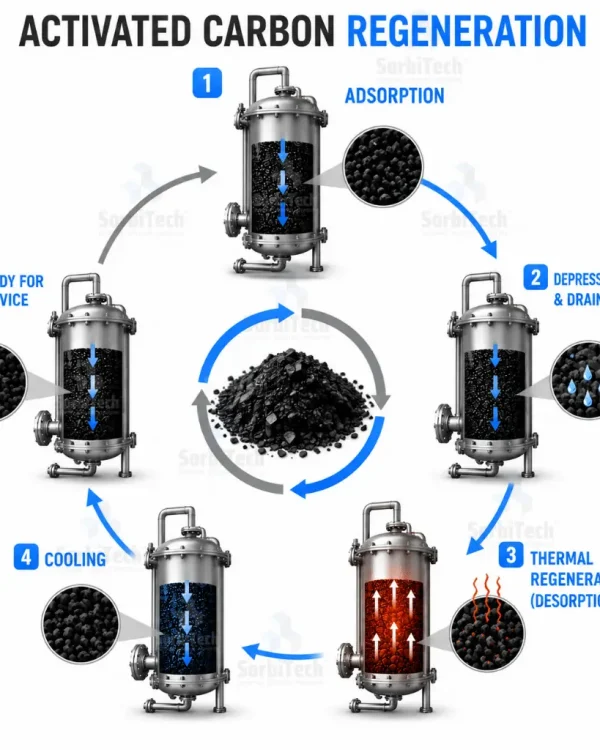
Choosing the right activated carbon starts with understanding how it is made. The two primary production methods, steam activation and chemical activation, create carbon products with fundamentally different pore structures, surface properties, and application strengths. This guide covers the technical differences between both methods, the resulting carbon properties, and the applications where each type delivers the strongest results.
What Is Steam Activated Carbon?
Steam activated carbon, also known as physically activated carbon, is produced through a two stage thermal process. First, the raw material (typically coconut shell or bituminous coal) is carbonized at 400°C to 600°C. Then, the carbonized material is exposed to high temperature steam (800°C to 1,100°C) in a controlled atmosphere.
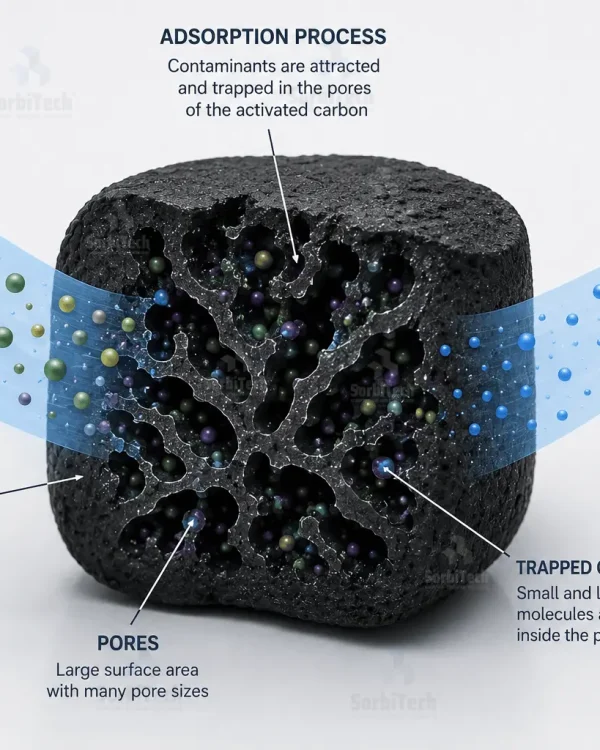
The steam reacts with the carbon through gasification, selectively removing carbon atoms to create and enlarge the internal pore network. This method primarily develops micropores (pores smaller than 2 nanometers), resulting in carbon with a high surface area relative to its pore volume. For a detailed explanation of the complete activation process, see our guide on what activated carbon is and how it works.
What Is Chemically Activated Carbon?
Chemical activation takes a different approach. The raw material (often wood or lignite coal) is impregnated with a chemical activating agent before thermal processing at lower temperatures (400°C to 700°C).
Common Activating Agents
- Phosphoric acid (H3PO4): most widely used, particularly for wood based carbons
- Zinc chloride (ZnCl2): historically common, now less used due to environmental considerations
- Potassium hydroxide (KOH): used for producing very high surface area carbons for specialized applications
The chemical agent acts as a dehydrating catalyst during heating, promoting pore development. After activation, the agent is washed out and recovered. This method produces carbon with a wider pore size distribution, including significant mesoporosity (2 to 50 nanometers) and macroporosity (above 50 nanometers).
Side by Side Comparison
| Property | Steam Activated | Chemically Activated |
|---|---|---|
| Activation Temperature | 800°C to 1,100°C | 400°C to 700°C |
| Pore Structure | Predominantly microporous | Broader: micro + meso + macropores |
| Typical Surface Area | 800 to 1,200 m2/g | Up to 1,500+ m2/g |
| Iodine Number Range | 900 to 1,200 mg/g | Often above 1,200 mg/g |
| Common Raw Materials | Coconut shell, bituminous coal | Wood, lignite coal |
| Hardness | High (coconut shell: 97%+) | Lower, generates more fines |
| Reactivation Potential | Excellent (multiple cycles) | Limited due to softer structure |
| Typical Form | GAC, Pellets | PAC, some GAC |
Higher iodine numbers and surface area do not always mean better performance. The pore size distribution relative to the target contaminant’s molecular size is equally important. A carbon with lower total surface area but the right pore geometry can outperform one with higher numbers but mismatched pore sizes.
Best Applications for Each Type
Where Steam Activated Carbon Excels
| Application | Why Steam Activated Works Best |
|---|---|
| Drinking Water Treatment | Micropores capture small organic molecules and chlorine effectively |
| Gold Recovery (CIP/CIL) | High hardness withstands abrasion; micropores capture gold cyanide complexes. For detailed selection criteria, see our guide on choosing activated carbon for gold recovery. |
| VOC Removal | Microporous structure captures volatile organic molecules from gas streams |
| Biogas Purification | Effective H2S removal; durable for multiple regeneration cycles |
| Mercury Capture | Works with impregnation for chemisorption of mercury species |
| Desalination Pre Treatment | Protects RO membranes; high hardness minimizes fines |
Where Chemically Activated Carbon Excels
| Application | Why Chemically Activated Works Best |
|---|---|
| Sugar Decolorization | Mesopores accommodate large color body molecules |
| Edible Oil Refining | Open pore structure allows effective bleaching and decolorization |
| Pharmaceutical Purification | Broad pore range handles diverse API impurity molecules |
| Beverage Clarification | Mesopores remove tannins, color compounds, and off flavors |
| Wastewater Treatment | Captures large molecular weight organic compounds from effluent |
How to Choose: A Decision Framework
Use the following criteria to guide your selection:
Select Steam Activated Carbon When
- Target contaminants are small molecules (molecular weight below 300 g/mol)
- The application involves gas phase treatment or vapor recovery
- High mechanical strength is needed for fixed bed filtration systems with backwashing
- The carbon will be reactivated and reused across multiple service cycles
- Consistent long term performance is a priority
Select Chemically Activated Carbon When
- Target contaminants are large molecules (color bodies, tannins, humic acids)
- The application involves decolorization or high molecular weight organic removal
- Carbon will be used as PAC in single dose batch treatment
- Very high surface area is needed to maximize single pass efficiency
- The process operates at lower temperatures where mesopore access matters
The most reliable way to determine the right activation type for your specific application is through laboratory analysis. Isotherm testing and small scale column tests using your actual process stream will confirm which carbon type delivers the best results. The activation method also affects the cost structure: chemical activation requires chemical agents but lower temperatures, while steam activation needs higher energy input but avoids chemical handling. For guidance on selecting carbon for water treatment applications, refer to our dedicated selection guide.
SorbiTech Carbon Range
SorbiTech manufactures both steam activated and chemically activated carbon products from the UAE. The range includes GAC, PAC, pelletized carbon, impregnated carbon, and the OraPure line engineered for gold recovery operations.
For technical consultation on carbon type selection for your specific process conditions, contact SorbiTech.